Helping tech founders, startups, investors, and talent get connected and discover events and programs across Wisconsin since 2017.
[New Episode] 🎙️ What if universities treated entrepreneurs the way they treat doctors and lawyers?
Episode 19 now available!Ep 19 - Jon Eckhardt, Pyle Bascom Professor, Wisconsin School of BusinessInside the Founder Forward Vision for UW-MadisonJon Eckhardt asked one question: what would Google do if it ran this university and wanted to produce more entrepreneurs? His team surveyed the entire student body. 20% had product or service ideas. They were in history, political science, women's studies, engineering, medicine. The university needed to create a better system to support them. This conversation covers the founder forward model he's building at UW-Madison: treating entrepreneurship as a real career path with institutional support on par with medicine, law, and engineering. We dig into why tech transfer was literally invented at Wisconsin in 1925 but only catches patent-based entrepreneurship, how Epic Systems emerged from UW-Madison with zero university patents, why a university functions more like a city than a company, how capital constraints have collapsed in ways most people haven't internalized, and Jon's personal North Star of opening a door somewhere in Northern Wisconsin and meeting a founder who came from this work. All that and more inside this episode Topics discussed
Key learningsEntrepreneurship is hiding in every department on campus. When Jon's team surveyed the UW-Madison student body, they found something the university didn't know about itself. Founders weren't concentrated in the business school. They were in history, political science, women's studies, engineering, medicine. About 20% of students said they had a product or service idea. On a campus of 50,000, that's thousands of people building things the institution had no system to support. The number itself is striking, but the implication is bigger. If you pull founders from every discipline into the same room, there's a commonality. Shared experiences, comradery, bodies of expertise. Universities already recognize that kind of common career identity for law and medicine. They don't recognize it for entrepreneurship. The founder forward model starts by simply acknowledging the population that already exists. For Wisconsin's ecosystem, this is significant. If even a fraction of those students get the support they need to launch, the volume of companies coming out of UW-Madison goes up dramatically. And that volume is what eventually attracts outside capital to the state. Tech transfer was invented at Wisconsin. And that model has limits. Most people don't realize this, but technology transfer as a concept was literally invented at UW-Madison. In 1925, Professor Harry Steenbock developed a way to increase vitamin D content in food. Instead of patenting it himself, he wanted the university to benefit. That led to the creation of the Wisconsin Alumni Research Foundation (WARF), which became the model universities around the world copied. The tech transfer model works when an invention happens in a lab and gets patented. It's responsible for millions of lives saved. But it misses something huge. It only catches entrepreneurs whose work intersects with patents. The Judy Faulkners of the world, who build companies like Epic Systems from knowledge acquired on campus but no patented technology, fall outside the system entirely. Jon was clear about this: he's not criticizing tech transfer. It's an incredible system Wisconsin should be proud of inventing. But the founder forward model is designed to capture what tech transfer can't. The founders who learn something on campus, take it into the world, and build something with it 5, 10, or 30 years later. The founder forward model treats entrepreneurship as a career path. This is the core idea. What if UW-Madison explicitly recognized entrepreneurship as a career path the same way it recognizes law, medicine, or journalism? What if it actively cultivated founders, invited them to Wisconsin, and helped them develop while they're here? It's not about building a "School of Entrepreneurship" silo. Entrepreneurship cuts across every discipline, so a siloed approach would miss the point. The model is about adjusting core institutional systems, like orientation, registration, and advising, to make entrepreneurial pathways more visible to anyone interested. They've already added an entrepreneurship module to the SOAR orientation that all first-year students go through, and they're tracking its effectiveness. The model also applies to faculty, not just students. UW-Madison has a strong history of faculty entrepreneurs, and the founder forward philosophy extends to making the university a place that attracts and supports them too. Jon put it simply: almost everyone involved in building this model is a founder themselves. It's being created by entrepreneurs, for the next generation of entrepreneurs. A university functions more like a city than a company. Jon offered a useful frame here. People sometimes try to treat universities like companies with a CEO at the top driving focused execution. That's not how academic institutions work. A university is more like a city. Distributed activity, frontier innovation happening everywhere, no single authority dictating direction. This matters for how change actually happens. You can't decree entrepreneurship into existence from the chancellor's office. You have to use tools like marketing, awareness campaigns, embedded touchpoints in registration and advising, and partnerships with faculty across departments. The work is about cultivating conditions for entrepreneurship to flourish, not mandating outcomes from the top. For anyone trying to drive institutional change, whether at a university, a large company, or a government agency, this frame is worth sitting with. The tools you use have to match the structure you're working within. Capital constraints have collapsed. Even if it doesn't feel like it. Jon walked through the historical arc of capital access. Centuries ago, you needed a king or queen to finance your idea. Then venture capital democratized access so anyone with an idea could approach someone with capital. Now, technology has collapsed the floor entirely. SaaS tools, AI, global distribution. The amount of capital needed to start most businesses has dropped dramatically while the ability to reach customers has gone up. That's the practical context for treating entrepreneurship as a career path. You don't need to raise $20 million to start. Many Wisconsin entrepreneurs have bootstrapped themselves into impressive outcomes without raising capital at all. But Jon was careful not to dismiss the capital challenges that still exist. He agreed that there are founders in Wisconsin right now who have done the work, produced the product, and would have secured funding in another environment. The theory behind the founder forward model is that if UW-Madison increases the volume and quality of companies coming off campus, it creates a situation where investors who aren't in Madison are missing out. That pull effect brings capital into the state, which then spills over to the broader ecosystem. Bootstrapping forces honesty. Jon and I dug into this one. When you raise $20 million for an idea, it becomes easy to lie to yourself for a long time. Foosball tables, people doing things, but no real economic foundation. When you have no capital, you can't lie to yourself. You have to make it work. Revenue, costs, alignment toward profitability. It's real. His philosophy: starve a business while it's searching for product-market fit. Suffer through it. When you find it and can show those economics, raising capital becomes a fundamentally different conversation. The friction of not getting funding is often a feature, not a bug. It forces founders to refine their model, their pitch, and what they actually offer. This connects directly to the ecosystem conversation. Wisconsin's capital gap is real, but Jon's point is that the constraint often creates clarity that abundance can't. The companies that survive bootstrapping arrive at investors with proof points that make the raise easier. Connecting student founders back to their hometowns could transform the state. Here's the part that hit me. UW-Madison attracts students from Green Bay, La Crosse, Eau Claire, Rhinelander, Ashland. The university knows who they are, and many of them say on the survey that they want to be founders. What if the university built systems to connect those students back to the business communities and ecosystems in their hometowns? This isn't a fantasy. It's already happening in pieces through gener8tor, WARF, TitletownTech in Green Bay, and others. The vision is to scale it into a deliberate program. A student from Ashland builds a company in Ashland after graduation. A founder from La Crosse builds in La Crosse. Capital and connections flow with them. Jon's personal North Star is the clearest version of this vision: he wants to be somewhere in Northern Wisconsin, open a door, and meet the founder of a company that came from this process. He knows it's going to happen. The work now is about scaling the system that makes those moments inevitable. The long-term vision is about human progress without coercion. Jon got philosophical at the end. The reason he cares so deeply about this work comes back to a concept from grad school called pareto optimal exchange. When an entrepreneur creates something new and someone willingly pays for it, both parties are better off. Nobody was forced. Society advances. Standards of living improve. Lives get saved. That's what drives him. More companies coming out of UW-Madison creating that kind of exchange. It sounds academic, but when you connect it to the specifics, a student from Rhinelander building a company that solves a real problem and employing people in that community, it becomes tangible. The founder forward model isn't just an institutional strategy. It's a theory of how Wisconsin grows. Upcoming episodes 👀
What is the Startup Wisconsin Podcast?It's a new show where you can learn about Wisconsin's growing tech scene. Hear the stories of startups, founders, investors, and the incredibly generous people making it happen every single day. Subscribe to the podcastToo busy right now but want to listen later? Have questions? |
Startup Wisconsin Newsletter
Helping tech founders, startups, investors, and talent get connected and discover events and programs across Wisconsin since 2017.
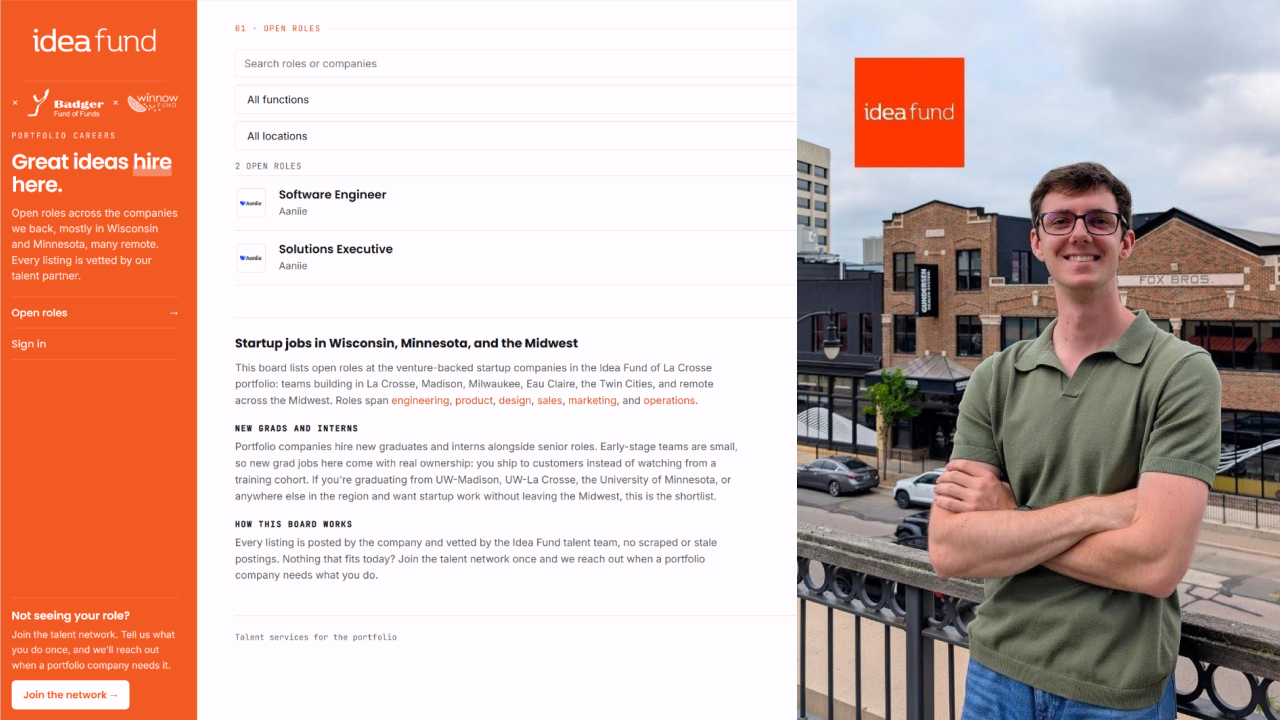
Startup Wisconsin Blog | August 25 2026 Featured article The Job Is Fine. Idea Fund of La Crosse Thinks That's the Problem. A college friend cut Travis Erath off mid-conversation to say "please, find me a job." Her job was fine. That was the whole complaint, and it turned out two other people in the room felt the same way. Travis is the new Talent Partner at the Idea Fund of La Crosse. He built a prototype of the portfolio career site while he was still applying for the role, and a good chunk...
Startup Wisconsin is organized by Headway, a digital product agency based in Green Bay, WI. Powered by our state sponsors, Nicolet National Bank and gener8tor. Hey folks! Jacob Miller here. Forward Fest starts August 17. Five days, roughly fifty sessions, all over Madison. That's a lot to sort through, so we asked Forward Fest board member Ross Larson which sessions he'd actually build his week around. That field guide is linked below, and every session is listed further down if you'd rather...

Startup Wisconsin Blog | July 28 2026 Featured article Your Field Guide to Forward Fest 2026 Fifty events in five days. Forward Fest board member Ross Larson shares the picks worth building your week around, from a sauna happy hour to a practical AI summit. He also tells the story of the 2015 breakfast that landed him the job he's had for 10 years. You cannot schedule the classmate. You can only be in the room. Read the field guide → The Startup Wisconsin Blog is sponsored by A Full-Cycle...