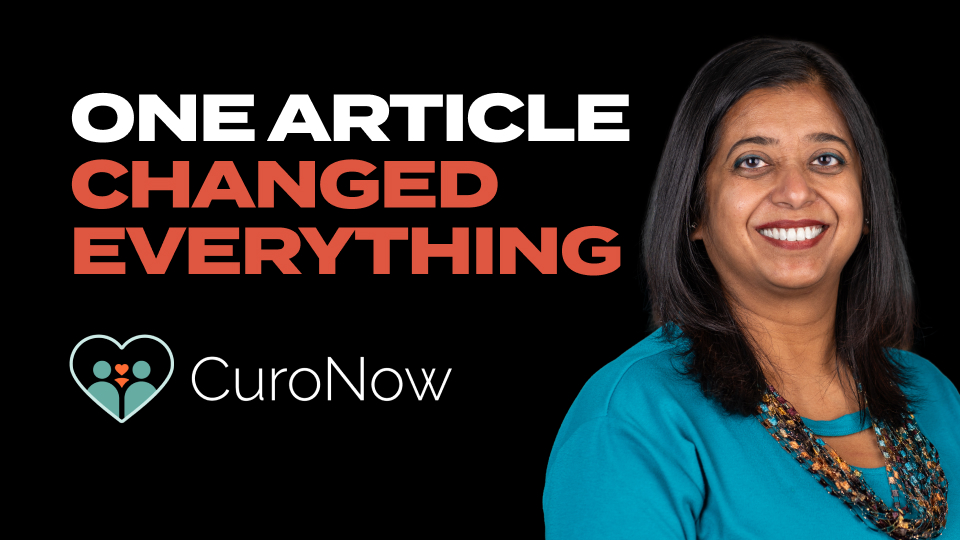
Episode 22 now available!
Ep 22 - Rukmini Banerjee, Co-Founder and CEO, CuroNow
Rukmini Banerjee read one article and could not put it down. Her first thought was not about her parents. It was about her sister.
The article said family caregivers of aging parents, especially parents with cognitive decline, face a 40% higher chance of facing the same struggles themselves later. Her parents live in Melbourne with her older sister. Her in-laws are in India. Her siblings are scattered around the world. Her sister was the one waking up at 4:00 AM to take a blood pressure reading, while Rukmini checked in by phone from Wisconsin.
Nobody chose that split. Her sister just happened to live closest, and the load followed geography. Rukmini still has the article saved.
That moment became CuroNow, a Madison startup building one shared place for medications, providers, appointments, documents, and the small daily observations that usually disappear into a group text.
She spent her career inside CUNA Mutual, Fetch Rewards, and Vouch Insurance. She was not looking to start a company. She was looking for her next job, went hunting for a tool that already did this, and kept finding things that were 60 or 70% right. She had also just turned 50, and figured if she did not do it then, she never would.
All that and more inside this episode
→ Listen to the Interview
Topics discussed
- The article that turned a personal frustration into a company
- Leaving the C-suite at 50 to become a first-time founder
- Finding a co-founder after six years together on a hospital board
- Why family care coordination breaks down across five apps and a group text
- The Health Tracker feature they almost did not build
- Privacy and HIPAA as a design principle instead of a compliance checkbox
- The Vault toggle that records where a will is without attaching it
- Home care pilots and why the aide is never in the family portal
- What Creative Destruction Lab actually feels like from a founder's seat
- Why she credits the Wisconsin ecosystem for getting them this far
→ Listen to the Interview
Key learnings
One article made it non-negotiable.
The research said family caregivers of aging parents, particularly parents with cognitive decline, are at roughly a 40% higher chance of facing the same challenges when they get old. Rukmini's head went straight to one sentence: I am doing this to my sister.
What stuck with me is that she was not the one carrying it. Her sister was doing the day-to-day caregiving, anxious all night, up at 4:00 AM with a blood pressure cuff. Rukmini's role was asking how things were going over the phone. That is the moment she says she stopped having a choice.
She was job hunting, not company hunting.
In late 2024 she had just transitioned out of her last role and was meeting people to figure out where to work next. Two friends were deep in it with their own mothers and their own siblings, so she offered to go find them a better tool. She has a math and computer science background and assumed one existed. What she found was 60 or 70% solutions, always more than one, always with a workaround stapled on.
The other half of the decision was timing. She had just turned 50, her last two roles were C-suite, and her kids were finally in middle school. Her read on it was blunt: if she did not do it then, she was never going to.
The co-founder came from a hospital board.
Rukmini and Pat Setji had known each other for over six years from serving together on the UnityPoint Health Meriter board, which brings in community members rather than filling every seat with doctors. Pat's story turned out to be the same story: a mother aging in Durham, a brother who is a Duke doctor near mom, a sister in Paris, and Pat in Madison.
They are yin and yang, which is exactly why it works. Rukmini is product and systems. Pat is sales, marketing, and relationships, with a deep pharma background behind her. They formalized it in the summer of 2025.
There is almost never one shared place.
Some families journal everything into Google Docs. Some scribble on Post-it notes stuck to a laptop, because this is 2% of a life that is already 200% full. Some divide it by role, where the doctor sibling handles the hospitals and the accountant sibling pays the bills.
What is consistent is that the digital version is always plural. The Walgreens app, the MyChart app, the UW Health portal, and something else. Then an emergency hits and everyone collapses into a group text, which works in the moment and fails a month later when nobody can remember which thread it was in.
The feature they almost did not build.
CuroNow has a Health Tracker for blood pressure, weight, fluid intake, and anything else you want to add. They only built it because two or three people asked. The team all wear Apple Watches, so they assumed nobody would care.
It became one of the most used things in the product. Some users do not trust wearables. Some do not own them. And there is no wearable for fluid intake, which Rukmini's own mother has to log every day. Then her own doctor asked for two weeks of blood pressure readings before adjusting a dose, so she logged it, screenshotted it, and sent it through MyChart.
Privacy was a design principle, not a checkbox.
This goes past HIPAA into plain privacy, and Rukmini frames it as a design principle from day one. A huge share of elder abuse is financial scams, so the stakes are not abstract. One full sprint went to a single behavior: when you come back to the app, nothing is visible until you re-authenticate with Face ID.
The best example is the Vault, where families store wills, powers of attorney, and, in one case, grandma's favorite chicken recipe. A user asked for a toggle marking physical location, so you can record that a will exists and that it is in the study, second drawer on the right, without attaching the document for everyone to read.
Three parties who have never been in the same room.
In home care there are three interested parties: the agency, the aide who walks into the house, and the family. All three talk one-on-one and never together. The bigger agencies do have family portals, with what Rukmini describes as incredibly low utilization, and the aide is never part of them at all.
Today the flow runs one direction, agency and aide reporting to family. What nobody has built is the family saying they visited mom last night and noticed something, so the aide walks in Friday morning already knowing. Rukmini puts it as moving from a compliance orientation to a personal one, telling the person who spends the most hours in that house that their voice matters.
Nobody warned her about the part with no off switch.
She has always pushed herself hard and always worked through vacations, so she thought she knew what she was signing up for. This is different. There is zero switch off. Even out with friends, the conversation finds its way back to CuroNow.
In the same breath she called it the most fulfilling work of her career, and the first time she has built a product she genuinely wants to use. She gave a huge shout out to the Madison and Wisconsin ecosystem for that, and was specific about why: she has seen cutthroat ecosystems, and this one is an all-ships-rise place where she can call anyone she has met even once and get a real conversation.
Upcoming episodes 👀
- Nadiyah Johnson (Milky Way Tech Hub)
- Brian Saetre and Candy Phelps (Frenting)
What is the Startup Wisconsin Podcast?
It's a new show where you can learn about Wisconsin's growing tech scene. Hear the stories of startups, founders, investors, and the incredibly generous people making it happen every single day.
See All 22 Episodes
Subscribe to the podcast
Too busy right now but want to listen later?
Let's make this easy for you.
Subscribe on YouTube
Follow on Spotify
Follow on Apple Podcasts
Have questions?
We've got you. Ask away!
jacob@startupwi.org